miércoles, 20 de mayo de 2015

Others Explorers


                                 OTHERS EXPLORERS


VASCO NUÑEZ DE BALBOA: 1 Septembre 1513, Spanish conquistador Vasco Nunez de Balboa (1475-1517 or 1519), born in Jerez de los Caballeros (Badajoz), departed from Santa Maria de la Antigua del Darien, along the Caribbean Sea (in the current Colombia), the first city in continental America, which had been founded two years earlier. The expedition, consisting of 190 Spaniards and a thousand Indians, arrived at the port on lands of cacique mask and with great difficulty crossed the Isthmus of Panama in search of a new sea, he had spoken indigenous. The September 25, 1513, following the instructions of indigenous guides, Balboa climbed to a peak and first beheld the Pacific, the largest in the world.
Resultado de imagen de vasco nuñez de balboa


AMERIGO VESPUCCI: Amerigo Vespucci (Florence 1451-Sevilla 1512) After the death of Berardi (1496), decided to pursue navigation. He became interested in travel Colón.En his first trip believed he had sailed along the coast of the eastern peninsula of Asia and eventually reach the Indian Ocean. Such was the goal of his second expedition, but Spain rejected its proposals and in 1500 entered the service of Portugal. He hoped that the seaworthiness of the Portuguese ships better serve their plans. He sailed from Lisbon on May 13, 1501 in command of three ships, heading to Brazil via the Cape Verde Islands, discovered the bay of Rio de Janeiro and continued further south along the coast of Patagonia, approaching the strait discovered Magellan.


Resultado de imagen de vespucci


 FERDINAND MAGELLAN:In 1519,Ferdinand Magellan led an expedition to find a sea route connecting the Atlantic and Pacific Oceans.The expeditions departed from Sanlúcar de Barrameda(Seville)and continued along the coast of South America until reaching a strait that led to the PacIsa ific Ocean.During the long voyage,Magellan reached to Mariana Islands and then the Philippines.He died in the Philippines,trying to subdue the indigenous peoples.His captain,Juan Sebastián Elcano,took control of the expedition and led the return voyage.


Resultado de imagen de ferdinand magellan


miércoles, 11 de marzo de 2015

the printing press


                                  THE PRINTING PRESS


The birth of printing dates back to China, in the year 593, when played for the first time and multiply, drawings and texts with the help of printed characters carved wooden boards (woodcut). The invention is because Buddhist monks, that permeated sizes color printing them on silk or paper rags. The movable type printing, and with them, typesetting, are due to the Chinese alchemist Pi Cheng (1040).


These techniques reached the West much later. Gutenberg knew the difficulty of print full pages woodcarvings and devised a more rational print mode, based on movable type. Thus, the first remains found in intaglio technique dating from 1446 and belonging to a German teacher who recorded on copper plates using a chisel. After printing is performed on wet paper and with the help of a press. This techniques would be enhanced in 1878 by the Austrian Karl Klietsch, using the application cylinder (photogravure).


Contemporary image of Johannes Gutenberg, inventor of printing with movable type.

This process will allow the massive, fast and cheap reproduction of relief printing forms based on lead plates.

In 1796, Alois Senefelder invented the Austrian printing technique called lithography. This is the first printing process level. If after fat printing ink on the stone is applied wet areas not accept, while adhering to the rest of the plate, being able to proceed to printing.


In 1822, after the French Ballanche Simon conceived the idea of ​​building an automatic composing texts, the American William Church manages to build the first machine of this type, the compounder. The idea was machined and maximum ease the complicated task of manually compose lead type typography, one by one, forming full texts, as was done since Gutenberg. This raises the first printing of automatic offset. This machine was perfected by Augustus Applegath and Edward Cooper, British engineers, I siguienddo the principle of the machine invented by Hoe, while still working only with loose sheets of paper. Some years later, in 1851, the British constructor T.

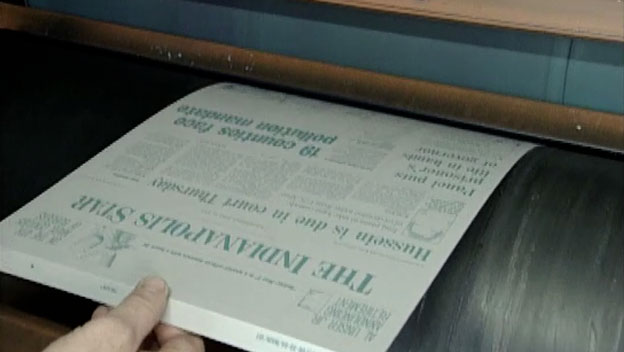
Nelson finally manages to develop a rotary printing on continuous paper rolls and, later, in 1863, the American inventor William A. Bullock get the patent for the first rotary press for printing books on continuous role model for Subsequent presses. This finding is particularly relevant because from the handpiece designed by Gutenberg to fuse types had hardly changed this technique. This technique, called hectografía, will soon become the standard procedure normally used for small print runs.


Horizontal rotating coil. Used created by John Walter III, the London newspaper The Times owner.

In 1884 highlights an important milestone printing history, the invention of the linotype by the German watchmaker Ottmar Mergenthaler, based on the fully automated composition of texts. Thus, once the composition of a line, the negative impression mold with liquid lead, yielding a lead seal for printing melted.


In 1904 the art of lithography, and overall printing world and reaches its peak with the development of offset printing, used today.


Resultado de imagen de la imprenta


jueves, 19 de febrero de 2015

medieval institutions in spain

                MEDIEVAL INSTITUTIONS IN SPAIN

Below, Medieval Institute faculty are grouped according to their areas of scholarly interest. Fields of study are listed alphabetically with brief descriptions of faculty research within those fields. Some faculty are listed in more than one area. Prospective students may wish to contact members of the faculty directly regarding their specialties and the potential for study at Notre Dame in those areas. Links below lead to faculty web pages that offer contact information and more biographical details.

The Medieval Institute faculty and students have access to library specialists in medieval studies who can assist them in their research. These librarians are key individuals in the scholarly activities of the Institute through the research help they provide, their skills in collection development, and their availability for classroom presentations. They each have personal areas of scholarly expertise as well:  David T. Gura, manuscripts curator (the transmission of Ovid in the Middle Ages, manuscript studies); and Julia Schneider, acting medieval studies librarian and reference specialist (liturgical topics, high medieval theology) who manages the Reading Room and can assist in locating books or using library resources.
Resultado de imagen de medieval institutions in spain


miércoles, 14 de enero de 2015

the hundred year war


          THE HUNDRED YEAR WAR
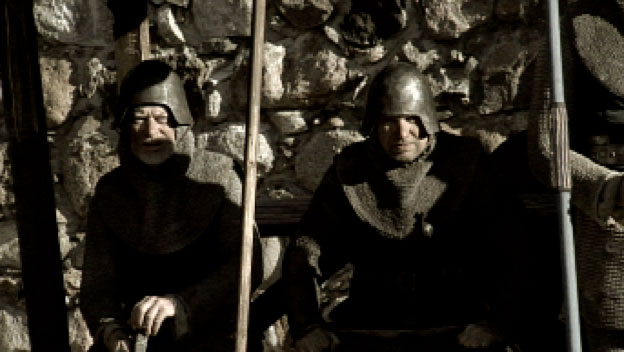
The name the Hundred Years’ War has been used by historians since the beginning of the nineteenth century to describe the long conflict that pitted the kings and kingdoms of France and England against each other from 1337 to 1453. Two factors lay at the origin of the conflict: first, the status of the duchy of Guyenne (or Aquitaine)-though it belonged to the kings of England, it remained a fief of the French crown, and the kings of England wanted independent possession; second, as the closest relatives of the last direct Capetian king (Charles IV, who had died in 1328), the kings of England from 1337 claimed the crown of France.


Theoretically, the French kings, possessing the financial and military resources of the most populous and powerful state in western Europe, held the advantage over the smaller, more sparsely populated English kingdom. However, the expeditionary English army, well disciplined and successfully using their longbows to stop cavalry charges, proved repeatedly victorious over much larger French forces: significant victories occurred by sea at Sluys (1340), and by land at Crecy (1346) and Poitiers (1356). In 1360, King John of France, in order to save his title, was forced to accept the Treaty of Calais, which granted complete independence to the duchy of Guyenne, now considerably enlarged to include almost a third of France. However, his son Charles V, with the help of his commander in chief Bertrand du Guesclin, by 1380 had succeeded in reconquering almost all the ceded territory, notably by a series of sieges.
After a hiatus, Henry V of England renewed the war and proved victorious at Agincourt (1415), conquered Normandy (1417-1418), and then attempted to have himself crowned as the future king of France by the Treaty of Troyes (1420). But his military successes were not matched by political successes: although allied with the dukes of Burgundy, the majority of the French refused English domination. Thanks to Joan of Arc, the siege of Orleans was lifted (1429). Then Paris and the lle-de-France were liberated (1436-1441), and after the French army had been reorganized and reformed (1445-1448), Charles VII recaptured the duchy of Normandy (the Battle of Formigny, 1450), and then seized Guyenne (the Battle of Castillon, 1453). The end of the conflict was never marked by a peace treaty but died out because the English recognized that the French troops were too strong to be directly confronted.
English territory in France, which had been extensive since 1066 (see Hastings, Battle of) now remained confined to the Channel port of Calais (lost in 1558). France, at last free of the English invaders, resumed its place as the dominant state of western Europe.
The Reader’s Companion to Military History. Edited by Robert Cowley and Geoffrey Parker. Copyright © 1996 by Houghton Mifflin Harcourt Publishing Company. All rights reserved.